When most people think of adaptive technology for those who are blind or visually impaired, screen readers, magnifiers, and phone applications often come to mind. And while these tools play an essential role in increasing access and independence, there is one skill that still holds powerful value today: braille.
With so many tools available today, braille might seem like a thing of the past, but that couldn’t be further from the truth. Braille continues to offer meaningful, everyday benefits from strengthening literacy to making daily tasks more manageable and efficient. Here’s why braille still deserves a place in your adaptive technology toolbox.

A Brief History of Braille
Braille has continued to empower individuals with vision loss for over two centuries, enabling them to navigate the world independently. The tactile system was invented in 1824 by Louis Braille, a French educator who lost his vision at a young age. His system of raised dots, which represent letters and numbers, allows individuals who are blind or visually impaired to read and write through touch.
Although technology continues to evolve, braille remains a vital tool for both literacy and independence. It offers a tactile alternative to visual or audio-based information and proves especially useful when other resources are unavailable or impractical.
Why Braille Still Has a Place in a Tech-Filled World
While screen readers and smart devices are beneficial and frequently used, they have limitations. Closed-circuit televisions (CCTVs) are stationary, smartphones require charging, and magnifiers don’t always work well in every environment. Braille offers a low-maintenance, no-power-required option that’s available anytime, anywhere.
Of course, braille isn’t for everyone. Health conditions like arthritis, neuropathy, or reduced finger sensitivity can make it more challenging to use. However, even in these cases, learning “survival braille”, a few key characters used for labeling or spot-reading, can still be valuable.
Building Stronger Literacy Through Touch
For individuals who are completely blind, braille plays a crucial role in developing literacy skills, such as grammar and sentence structure, which are difficult to grasp through audio or visual formats alone.
Additionally, braille supports digital literacy. Tools like braille keyboards and notetakers make tasks like taking notes, writing emails, or drafting documents more accessible and efficient. Keep in mind, braille doesn’t have to be your only method of reading. Screen readers, audiobooks, and radio reading services, such as Radio Talking Book, are also great options. The key is to find a combination of resources that work for your lifestyle and comfort level.
Everyday Uses for Braille
When considering braille, one might view it solely as a means for literacy, which is not entirely accurate. Braille can be used in specific situations, including finding the right button in an elevator or identifying office or apartment numbers. Braille signage is required by law in many public spaces under the Americans with Disabilities Act (ADA), making the world more navigable for individuals with vision loss.
Its benefits multiply when combined with braille dots or labels that can be attached to just about anything. In the kitchen, braille dots can help you organize and quickly find items in your fridge, cabinets, or pantry. In your closet, you can sort and identify clothing, as well as distinguish colors. Braille can help you find the correct prescription bottle in your bathroom, distinguish between shampoo and conditioner, and organize your hygiene and cleaning products. All of this is possible without looking for a magnifier or a phone application. In these scenarios, however, braille can often be the quickest and most efficient way for blind individuals to read.
Start Your Learning Journey With Outlook Enrichment
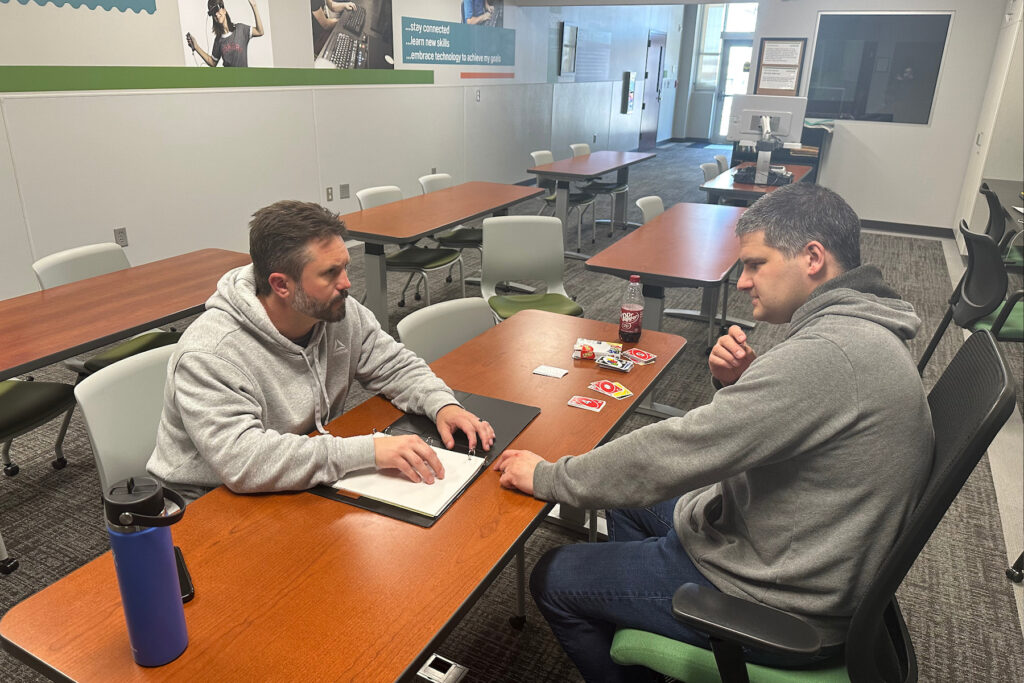
Learning braille may feel overwhelming at first, but you don’t have to do it alone. At Outlook Enrichment, braille instruction is part of our Adaptive Technology program, designed to help you achieve your personal goals, whether you’re new to braille or looking to brush up on your skills.
Sessions are held weekly for one hour and focus on foundational braille concepts and rules, helping you build confidence step by step. Our team will work with you on practical applications, such as labeling household items, identifying key signage, or utilizing braille technology. Whether you’re aiming to learn “survival braille” for everyday use or are interested in becoming more fluent, we’re here to support your journey toward greater independence.

Braille remains a powerful and practical system for anyone navigating vision loss. Whether you’re using it to label everyday items, build literacy skills, or complement other adaptive technologies, braille offers greater independence and confidence in daily life.
If you’re ready to add braille to your adaptive technology toolbox, we’re here to support you. Complete our contact form to get started. We’d love to help you take the first step.